The engineering behind Comet
The engineering behind the Comet Fuel Saving System
CFSS is a unique system for monitoring, controlling and reducing the consumption of all fuel types — gasoline, diesel, propane and other petroleum derivatives, both liquid and gaseous.
Patented
The CFSS unit is made of a patented blend of metal alloys.
Up to 60%
Reduction of greenhouse gas emissions when properly installed.
Under 1 year
Return-on-investment period in most completed projects.

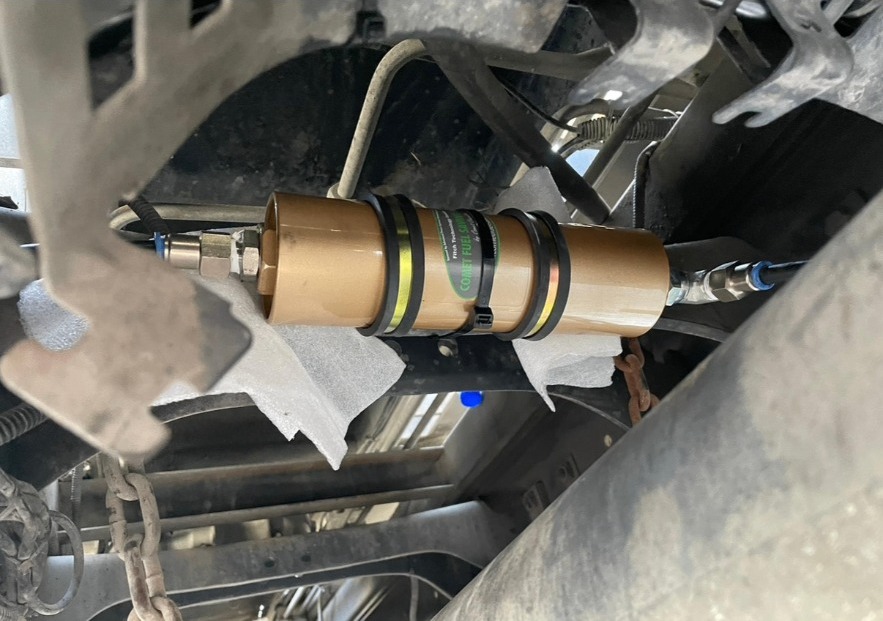
CFSS unit
How the system acts on fuel
CFSS does not change the engine — it changes the fuel before it enters the engine. That is the origin of every effect we later measure.
Fuel reformulation at the molecular level
The body of the CFSS unit is made of a patented blend of metal alloys which, on contact with hydrocarbon-based fuel, alters the fuel's molecular arrangement and structure — increasing the octane or cetane value and enabling more complete combustion.
More energy from the same amount of fuel
Reformulated fuel burns better and releases more energy, so the same power and the same duty cycle are achieved with lower consumption.
Lower emissions and fewer deposits
Better combustion reduces smoke, soot and greenhouse gas emissions, removes carbon deposits and extends the life of engine oil and the engine itself.
No mechanics and no maintenance
The CFSS unit is a non-mechanical device with no consumable parts. It is installed in the fuel line, between the tank and the engine, and operates for years without servicing.
Implementation
Three components working together
CFSS implementation guarantees reduced fuel costs and simplifies the planning, monitoring and adjustment of all functions affecting cost — through the combined effect of three components.
CFSS unit for fuel homogenization and reformulation
A compact catalytic device that enables higher-quality combustion and a permanent reduction in fuel consumption. It is installed in the fuel line, without any engine modification.
Core system component
CFSS unit for tank control
Prevents unauthorized fuel transfer and siphoning. The system compares data on the quantity dispensed at the pump, tank filling and actual engine consumption.
Multiple-stage control
CFSS unit for monitoring
Real-time GPS vehicle tracking, with panic button and black box options. Data is transmitted directly to the control center via the GSM network.
Telematics and fleet management
Fleet management
Fleet savings and management system
The Comet fuel-saving and fleet management system reduces overall transport costs and represents a powerful tool in the hands of company management.
Real time
GPS location and data transmission to the control center via the GSM network.
No modifications
Installation does not change the vehicle's interior or performance.
Guarantee
The functionality warranty lasts for the entire period defined by the contract.
Training
Technical support and crew training are included in the delivery.
Additional benefits
What else implementation delivers
In addition to fuel savings, the system cross-checks data on the amount dispensed at the pump, tank refills and actual engine consumption — thus closing the control loop.
Real-time consumption insight
Vehicle tracking, diagnostics, routing and dispatching in one place — we don't provide dispatching, we facilitate it.
Mileage and operating hours
They are read out for any time interval, without manual logging and without route planning, together with engine operation.
Protection against misuse
SMS alert or e-mail report if a vehicle leaves the designated route or is used outside working hours.
Driving behavior analysis
Route deviations, stops and route planning are recorded and used to correct work habits and operations.
Event reconstruction
The collected data allows for reconstruction of a traffic accident and verification of the circumstances in which it occurred.
Alarm and notification
When a vehicle alarm is triggered, the built-in device notifies the client via SMS message or phone call.
Technical framework
Application specification
The framework within which the system is designed and delivered, regardless of whether it is a fleet, a mine or a plant.
Principle of operation
A non-mechanical catalytic unit (US patent) in the fuel line, between the tank and the engine.
Fuel types
All hydrocarbon-based fuels — liquid and gaseous.
Guaranteed savings
5% on gas installations; minimum 7% on liquid fuels. In practice, the most common savings on liquid fuels is 8–12%.
Emissions
Reduction of greenhouse gas emissions up to 60%, with a visible reduction in smoke and soot.
Maintenance
No consumables and no service intervals; extended maintenance intervals for engines and boilers.
Return on investment
In most cases shorter than one year.

Fuel types
The catalyst works on all hydrocarbon fuels
The same principle applies to liquid and gaseous fuels — from gasoline and diesel to heavy fuel oil and marine fuels.
Gasoline, E10 and E85
Diesel
Biodiesel
Propane and LPG
Fuel oil (#2, #4, #6)
Fuel oil, MDO and Bunker C
Natural gas
Other petroleum derivatives
Laboratory confirmation
Findings of independent testing
The effects of CFSS have been examined at faculties of the University of Belgrade, independently of field measurements at clients.
Univerzitet u Beogradu
Faculty of Chemistry, University of Belgrade
Testing established an increase in fuel calorific value of 2 to 3%, together with a reduction in ash content of 28.4% under static and 47.4% under dynamic conditions.
Univerzitet u Beogradu
Faculty of Technology and Metallurgy, University of Belgrade
The study showed that the number of particulate matter in exhaust emissions is negligible — which is particularly significant from an environmental protection standpoint and is achieved simply by installing the device.
Field measurements
Results measured in operation
The same system, different classes of assets and fuels — every measurement was conducted by comparison with a control asset or a measured baseline.
7,75%
savings over 12 months
Veliki Krivelj Copper Mine — Bor
20 BELAZ 75306 dump trucks with a 220-ton capacity, powered by CUMMINS QSK60-C engines. The system was tested for 12 months. In August, the dump truck without CFSS consumed 31,600 L of diesel over 294 engine hours (107.48 L/mh), while the vehicle with CFSS consumed 30,010 L over 306 engine hours (98.07 L/mh).
7%
fuel savings in the three-month measurement
Ugljevik Mine and Thermal Power Plant
A fleet of 35 BELAZ 75135 dump trucks with a 110-ton capacity. Over three months, the consumption of vehicle BL16, fitted with CFSS, was measured at 75,450 L. The control vehicle without the system consumed 81,169 L over the same period.
8,54%
savings on diesel fuel
JKP GSP Beograd
A city bus fleet in regular operation, diesel fuel, measurement under real urban driving conditions.
5,5%
savings on natural gas
R.A.K. Ceramics — Ras Al Khaimah
An industrial plant running on natural gas, continuous production regime in the United Arab Emirates.
10%
savings on diesel fuel
Taşyapı
A Turkish construction company — heavy machinery and cargo vehicles in high-load duty cycles.
approx. 10%
savings on heavy fuel oil
Trayal korporacija
An industrial plant running on heavy fuel oil, continuous operation of the boiler system.
Implementation references
Where CFSS has been installed so far
The system has been implemented in mining, energy, industry and construction, in Serbia and abroad.
- JP Elektroprivreda Srbije (EPS)
- Veliki Krivelj Copper Mine, Bor
- Majdanpek Copper Mine
- Trayal korporacija
- R.A.K. Ceramics — Ras Al Khaimah
- Tarkett
- Kraljevo Heating Plant
- Pančevo Heating Plant
- Sevojno Copper Rolling Mill
- Taşyapı — Turkey
- Ugljevik Mine and Thermal Power Plant
Next step
Let's walk through the engineering using your assets as the example.
A technical session covering engine classes, fuel type, duty cycles and how savings would be measured in your operation.
Schedule a technical session